
Study the competition
Read a rival's numbers, compare channels, and learn from their thumbnails.
A 3-minute video version of this guide will play here. Everything it shows is written out below.
Before you make a video, it helps to know what already works in your niche. The Competitor tool reads any YouTube channel's public numbers and the patterns in its titles. Benchmark compares up to four channels side by side, and the Thumbnails wall shows what their most viewed thumbnails have in common. This guide studies the competition for The Food Archive, a food history channel.
Before you start
A YouTube Data API key. Add it in Settings > API keys. It's free, with 10,000 units a day; one channel analysis uses about 3.
Your AI model, for the AI pattern read. The numbers work without it.
1. Pick the right competitors
A competitor is a channel that makes the same kind of video for the same viewers, not just any channel on your topic. For The Food Archive, which makes narrated food history documentaries, we picked these four:
Channel | Subscribers | Why it's on the list |
|---|---|---|
Weird History Food (@weirdhistoryfood) | 780,000 | Narrated food history documentaries, the same kind of video as The Food Archive. The main rival. |
Tasting History with Max Miller (@tastinghistory) | 4.5 million | The biggest food history channel. Shows what the top of the niche looks like. |
Townsends (@townsends) | 2.99 million | 18th century cooking and food preservation, a close topic. |
Old Glory Days (@oldglorydays77) | 130,000 | A faceless food nostalgia channel, growing fast. Closest to what a VidNexus channel can reach. |
Mix sizes. The leaders show what's possible; a channel close to your size shows what's reachable now. To find candidates, search YouTube for your next topic and note the channels that keep coming up. The handle is the part of the channel's address after the @, for example youtube.com/@weirdhistoryfood.
2. Analyze one channel
Open Research and, under Discover, click Competitor.
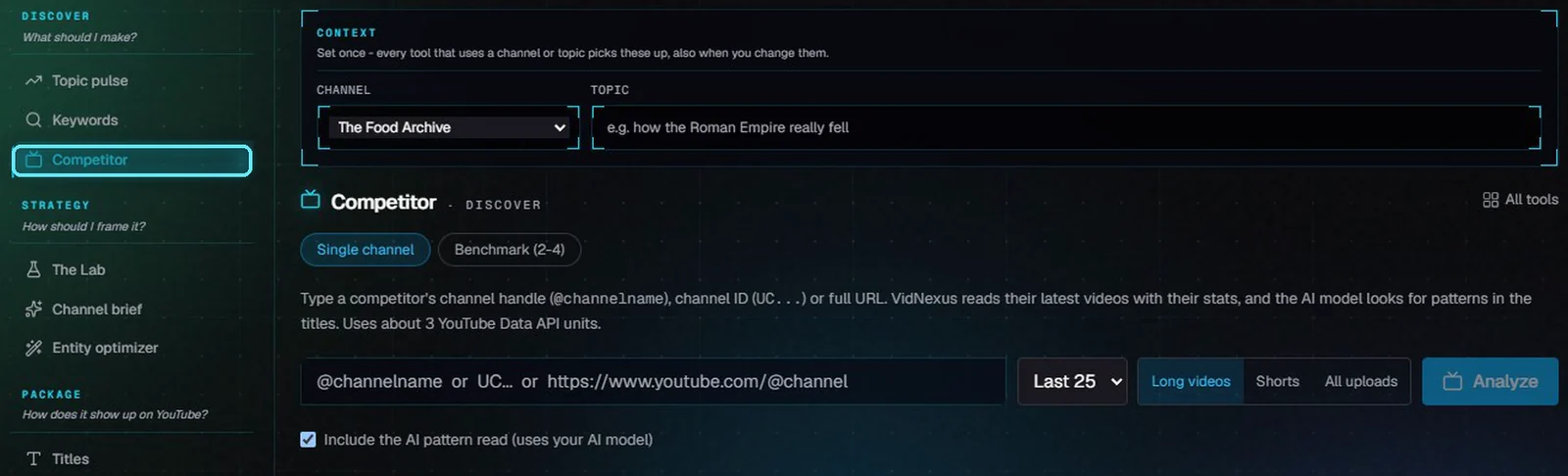
Competitor, under Discover.
Type the channel's handle, channel ID or address. We used @weirdhistoryfood.
Pick how many videos to read (Last 25) and which ones: keep Long videos selected.
Leave Include the AI pattern read ticked and click Analyze. It takes about 20 seconds.
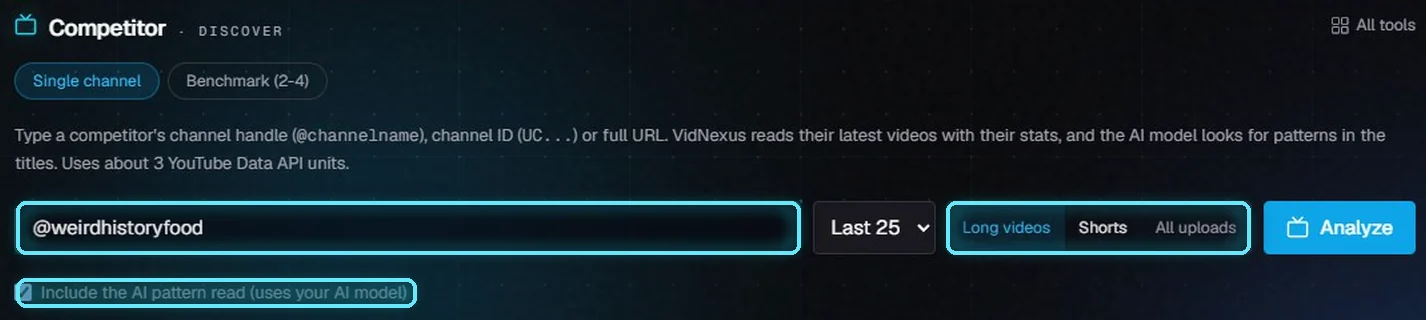
The handle, Last 25, Long videos and the AI pattern read.
Many channels post Shorts as well as long videos. A Short can get far more views in a minute, so mixing them in makes the averages meaningless. The three choices:
Choice | What it reads |
|---|---|
Long videos | The channel's Videos tab: no Shorts. The default, and the right choice for comparing long videos. |
Shorts | The channel's Shorts tab only. |
All uploads | Everything, newest first. Averages mix Shorts and long videos, so read them with care. |
The numbers
Weird History Food has 780,000 subscribers, 143.3 million views and 521 videos. Their last 25 long videos average 136,700 views (median 102,700). They post every 3 days, and the top video, What Went Wrong For Popeyes, has 422,900 views.
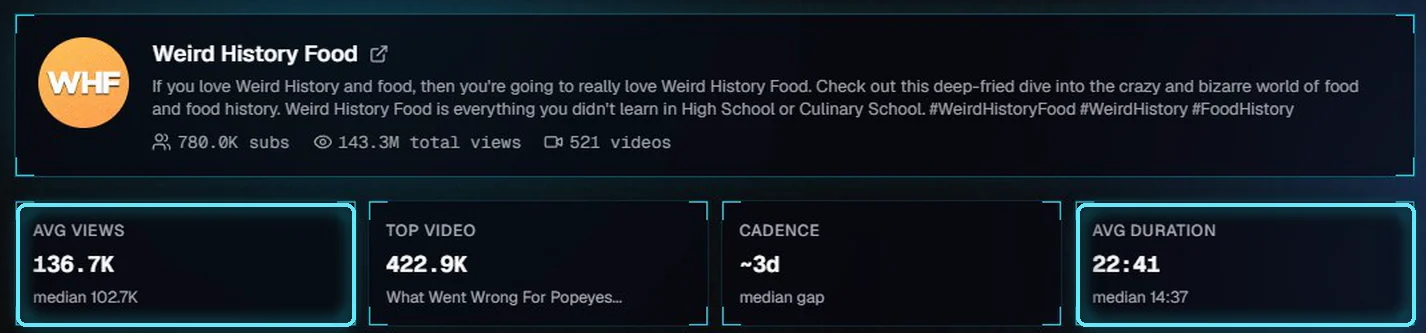
Average views, top video, cadence and duration, each with its median.
Number | What it tells you |
|---|---|
Avg views (median) | How a typical video does. The median ignores the odd hit or flop, so it's usually the fairer number. |
Top video | Their best video in the sample. Open it to see what the title and thumbnail did differently. |
Cadence | The usual gap between uploads, in days. |
Avg duration (median) | How long their videos run. Compilations and live streams pull the average up; trust the median. |
Their average video runs 22:41, but the median is 14:37: a few hour-long compilations pull the average up. Read the medians first.
The charts
Title length vs avg views groups the videos by how long their titles are. Here, titles of 30 to 49 characters average 165,100 views, the best band. Upload timing heatmap shows when their uploads went out, in your time zone, and which slot got the most views.
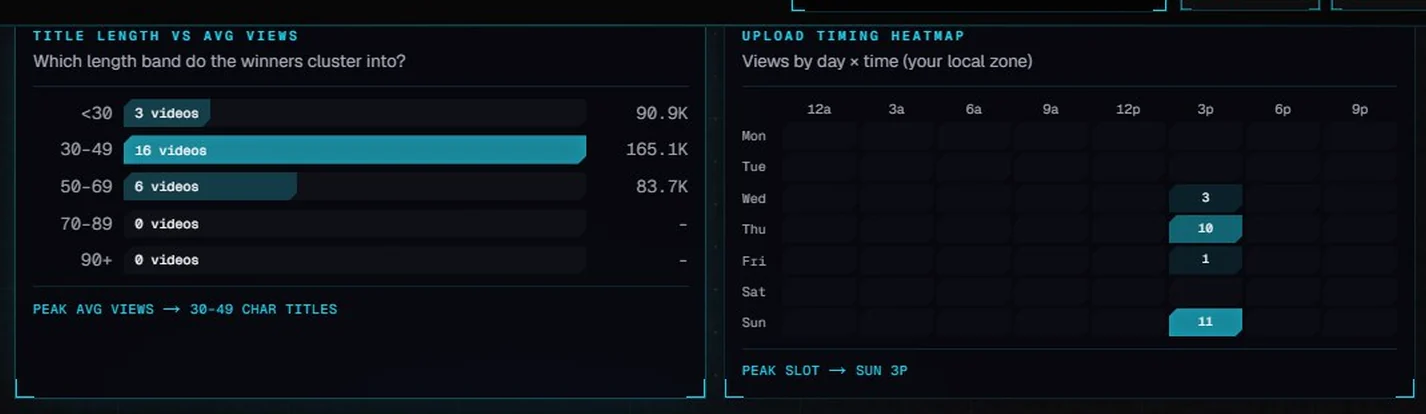
Title length bands and the upload timing heatmap.
The AI pattern read
Your AI model reads the titles, best performers first, and sums up what works: a one-line takeaway, their title formulas, top topics and hook patterns. For Weird History Food it found rise and fall stories about food brands, with money or failure in the title ("The Rise And Fall Of [Brand]", "What Went Wrong For [Brand]").
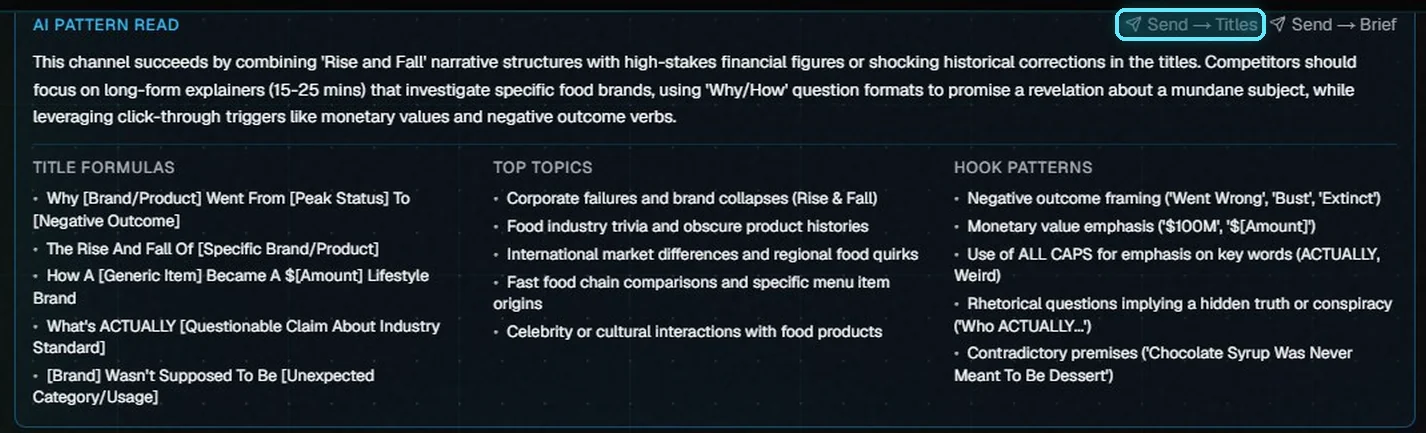
The AI pattern read, with Send to Titles.
Treat it as a starting point. It's a model's reading of the titles, not of the videos. Check it against the table below.
The videos
Every video is listed with its views, likes, comments, length and date. Click a column heading to sort by it, and click a title to open the video on YouTube.
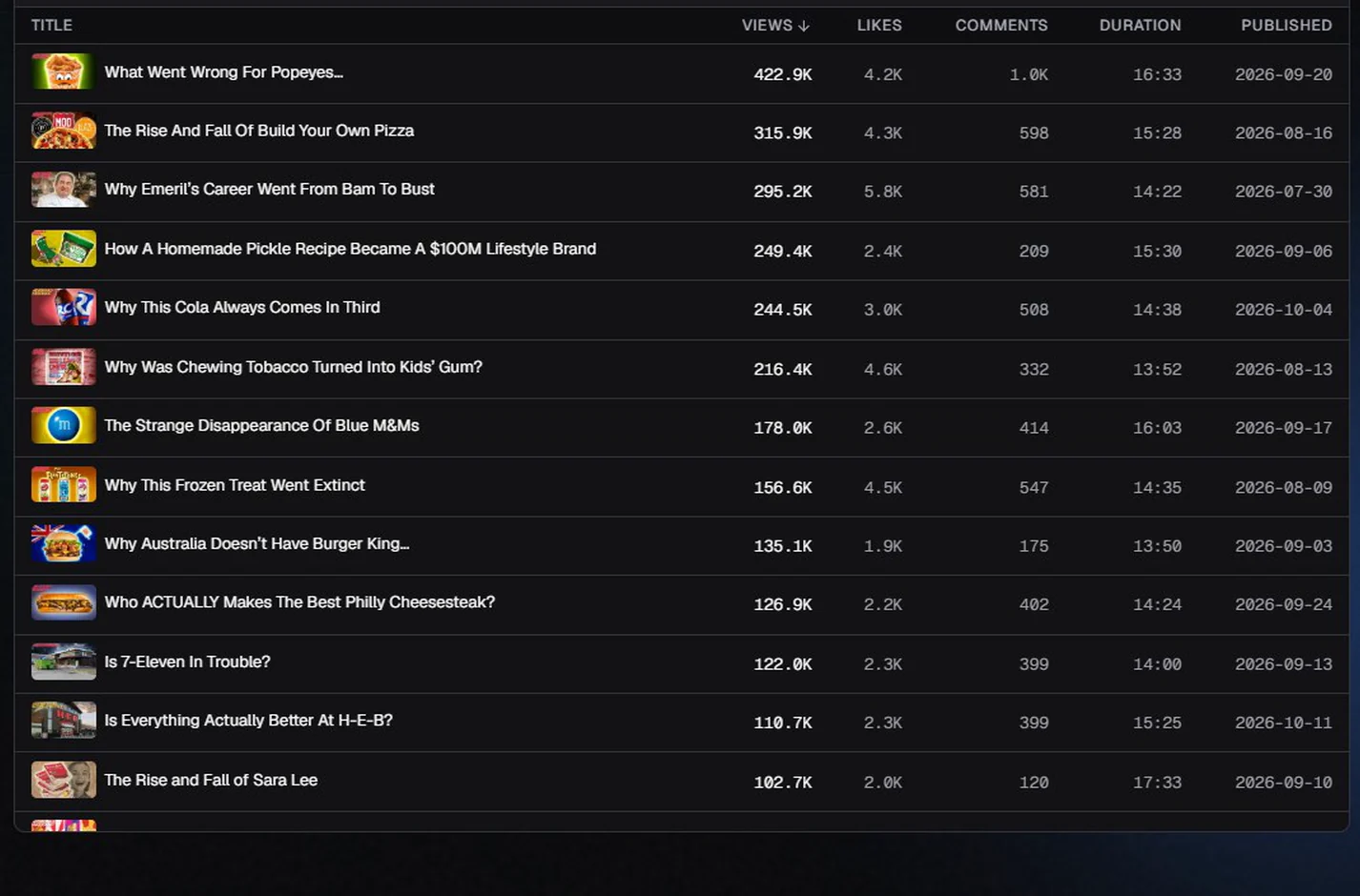
The last 25 long videos, sorted by views.
Use what you found
Click Send to Titles to put their title formulas into the Titles tool, ready for your next title ideas, or Send to Brief to add the patterns to your channel brief. Adapt the formula; don't copy the title.
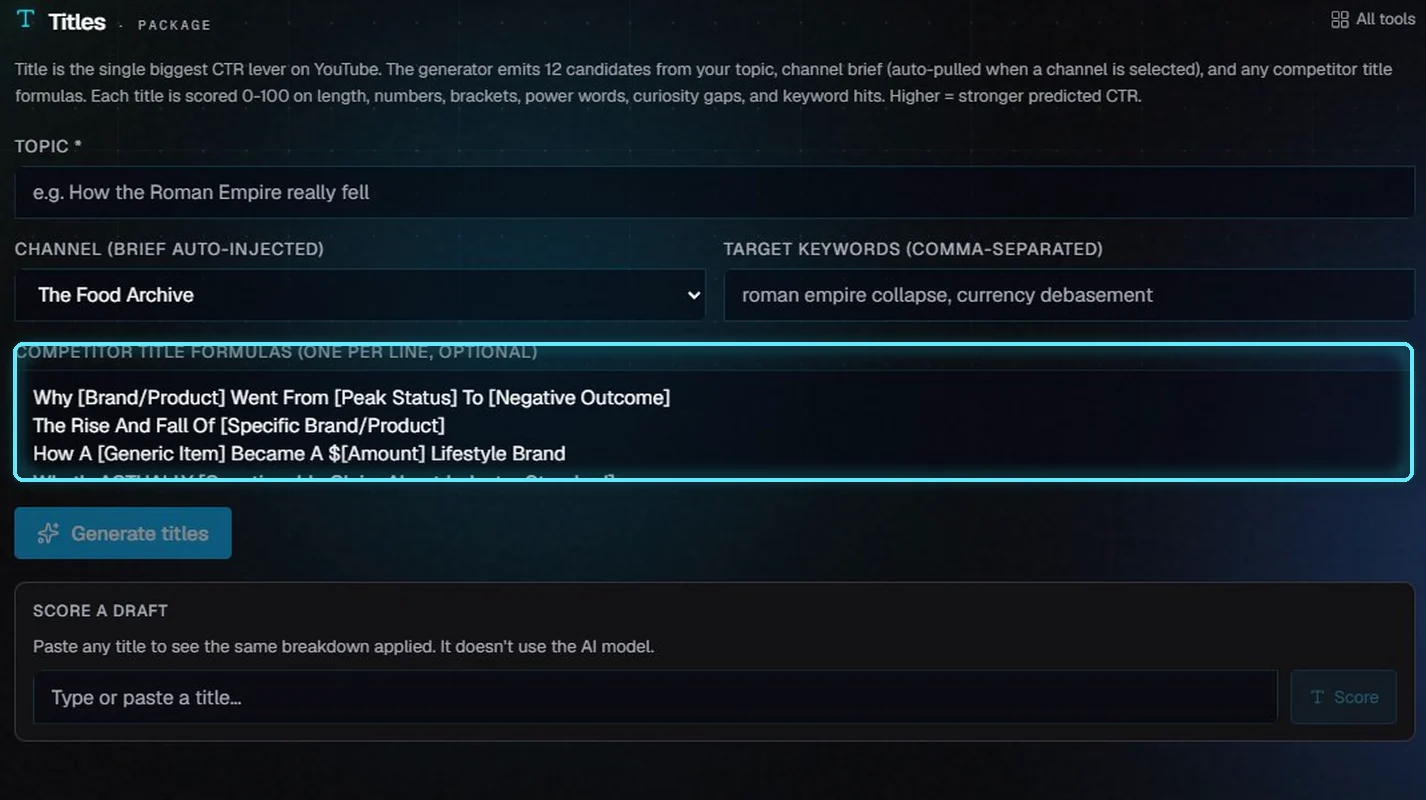
The formulas arrive in Titles.
3. Benchmark up to four channels
In Competitor, click Benchmark (2-4).
Type 2 to 4 handles, separated by commas. We used
@tastinghistory, @townsends, @weirdhistoryfood, @oldglorydays77.Keep Long videos and click Benchmark. It reads each channel's last 15 videos; the AI read is skipped so it stays quick.
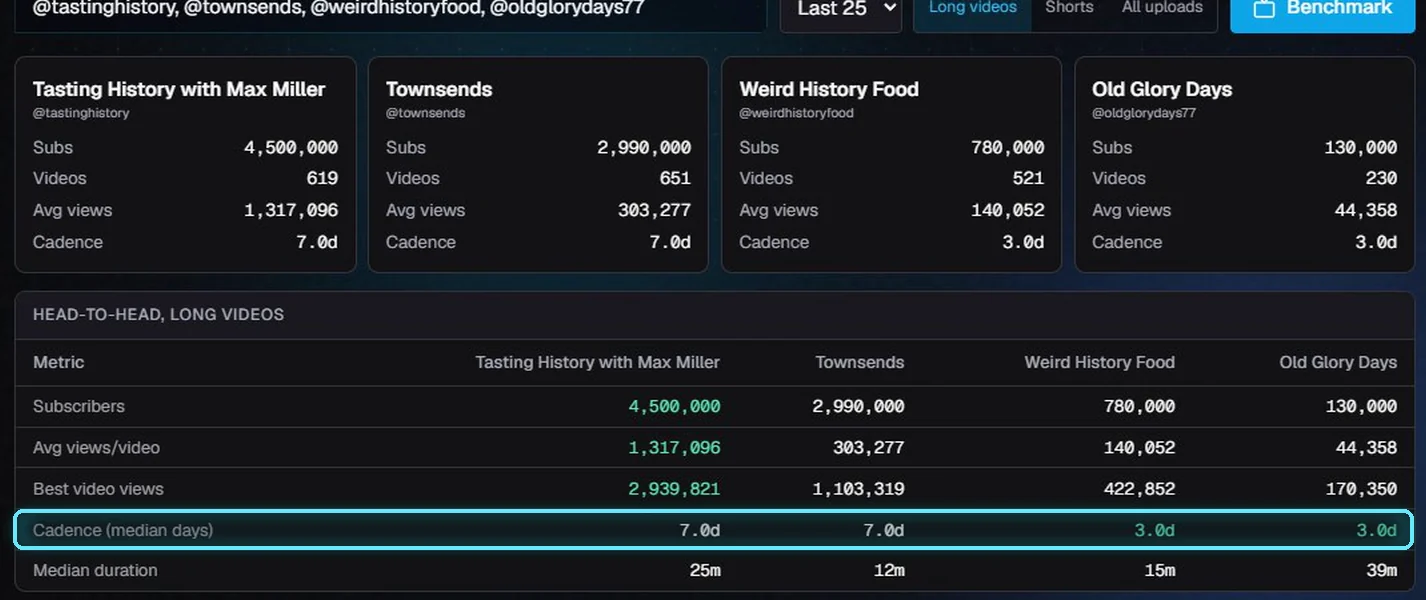
A card for each channel, and the head-to-head table.
In the head-to-head table, the leader of each row is green. For cadence, fewer days between uploads leads; median duration has no leader, because longer isn't better or worse.
What it told us: Tasting History averages 1.3 million views a video, about nine times Weird History Food. But Weird History Food and Old Glory Days post every 3 days, against every 7 for the two leaders, and Old Glory Days' videos run almost 40 minutes. A smaller channel can win on rhythm and length while the big names win on reach.
4. The thumbnail wall
Under Package, open Thumbnails.
Choose Competitor, type the handle, keep Long videos and click Load.
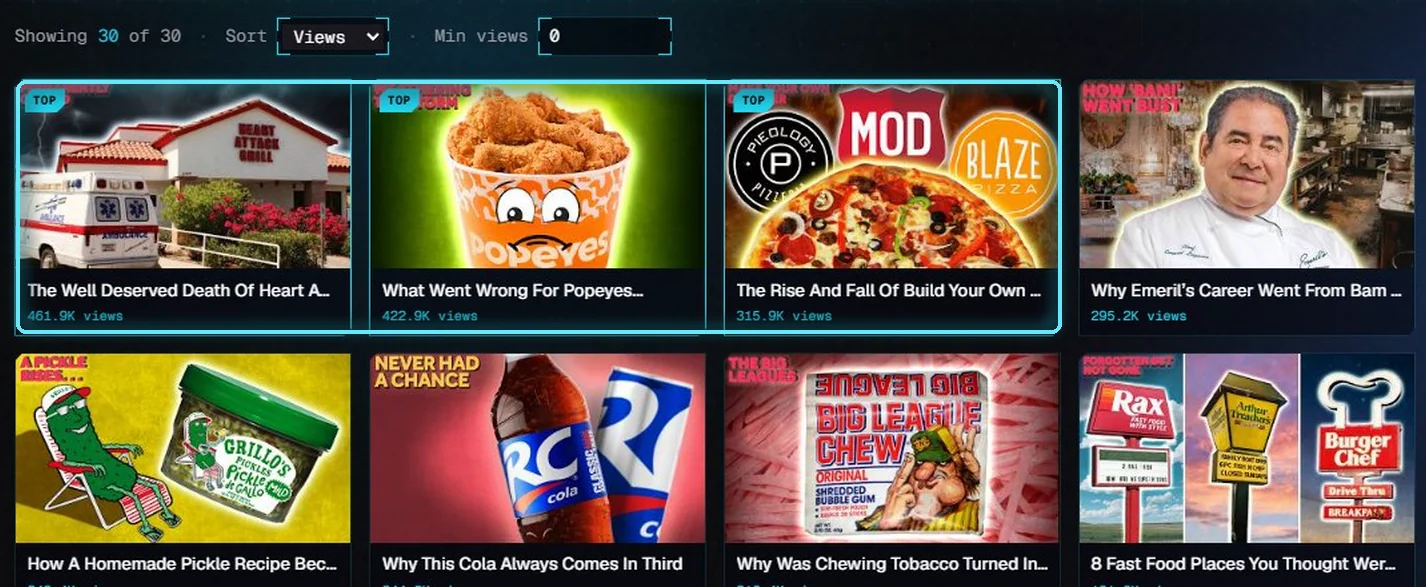
The three most viewed glow.
The three most viewed thumbnails glow. Look for what they share. On Weird History Food: one big subject (a building, a bucket of chicken, a pizza), a brand you recognize at once, and a short line of text in the top corner.
Use Sort to order by views, likes or date, and Min views to hide the weaker videos when the wall gets crowded. My channel shows your own thumbnails once the channel is synced (Channels, then Sync).
Tips
Compare like with like. Long videos with long videos, Shorts with Shorts.
Medians before averages. One viral video or a few compilations can skew an average.
Three to five channels is enough. Include one close to your size.
Check again every month or two. What works in a niche changes.
Borrow the pattern, not the title. Send the formulas to Titles and write your own.
Troubleshooting
"Add a YouTube Data API key in Settings > API keys". The tools need a YouTube Data API key. Add it, then try again.
"Channel not found". Use the handle exactly as it appears in the channel's address (youtube.com/@handle), or paste the whole address.
The AI pattern read is missing. A notice says the AI model took too long or couldn't read the titles. The numbers are complete; click Retry, and check that your AI model is running.
"VidNexus told them apart by length". YouTube didn't return the channel's Videos or Shorts list, so videos of 3 minutes or less were counted as Shorts. The numbers are still right in almost every case.
"No Shorts in this channel's latest uploads". The channel doesn't post Shorts. Pick Long videos.